 Gun Movie Camera
 The rubber-band guns
 Machine Gun With Everything

A general purpose machine gun (GPMG) in concept is a multi-purpose weapon, a machine gun intended to fill the role of either a light machine gun or medium machine gun, while at the same time being man-portable. However, performance in either role may be inferior to a weapon specifically designed for that role. In modern practice, they are air-cooled medium machine guns firing rifle cartridges such as the 7.62x51mm NATO. They are generally operated from a stationary prone position from either a bipod or tripod, or mounted on a vehicle, as they are usually too powerful and heavy to be fired effectively on foot from an unsupported standing position or on the move by some Army units in the world, although the British Army units of Royal Marine Commandos, Parachute Regiment, also first line combat battalions such as the Royal Regiment of Fusiliers and of course the world famous SAS are known to do this with devastating effect.
The term GPMG (or "Gimpy" in British Army slang), which comes from the Belgian-French name Mitrailleuse d'Appui General or General Purpose Machine guns (GPMG), became popular for describing medium machine guns used in multiple roles. The original Belgian-French term Mitrailleuse a Gaz is also known to be used. The mediums fired rifle caliber ammunition, but had some concessions for more extended firing and more general usage. This generally included both bipod and tripod/pintle mounting options and quick-change barrels. The first medium machine gun used as a GPMG traces back to World War I, where aircooled medium machine guns were used in many different roles, typically with larger magazines on aircraft, tanks, and ships, and in lighter configurations by infantry on bipods or tripods.
During the inter-war period, Germany developed the Maschinengewehr 34, or MG34, from scratch as a GPMG, as opposed to an adaptation of an existing weapon, such as the MG08/15. The MG34 was air-cooled, belt-fed and had the ability to be mounted on a variety of fixtures and employed in several different roles. Notably, the MG34 remained the standard co-axial weapon for Nazi German vehicles through the Second World War. The MG34 was successful enough during use in the opening stages of the Second World War that the concept of the GPMG was adopted in many other post-WWII armies. The MG 34's immediate successor in Wehrmacht service, the MG42, was the most versatile and effective machine gun design of the Second World War. The MG3, a direct descendant of the MG42, is still in service with the German Army and others.


The Belgian FN MAG, 'Fabrique Nationale' 'Mitrailleuse d'Appui General (general purpose machine gun) has long been the most widely-used GPMG among NATO and other western armies. The British Army and other Commonwealth forces used it to replace the venerable Vickers Gun,in the late 1950's under license from FN. Using the original FN design by Ernest Vervier the Royal Ordnance factory in Enfield England introduced the FN MAG 58 variant L7A1 into British Army service, known as the "Gympy"(Sometimes spelt "Jimpy") in British Army slangand is still in service today (2009) capable of firing 700 rpm at targets up to 3000m (when mounted) at a velocity of 838 mps.

The US Army has adopted the FN MAG as the M240 to replace the previous US GPMG (also widely used by allied nations), the M60 machine gun. The US Army uses the M249 - the MINIMI - as its light machine gun/squad automatic weapon, and the M2 machine gun (using the .50 BMG cartridge) is used in the heavy machine gun role.
In the late 1956, the Canadian military adopted the FN MAG as the C6A1 GPMG along with the purchase of the FNC1 and FNC2's. Even though the C1's and the C2's have been replaced by the C7A1/ C7A2 rifle and the C9A1/ C9A2 LMG, the C6 is still used as a GPMG and is held in such high regard in the Canadian Army that two are deployed in each platoon's weapon detachment.
Since the late 1950s or early 1960s, the Czechs produced the vz. 59 general purpose machine-gun in both 7.62x54mmR and 7.62 mm NATO (for export models), for which light and heavy barrels were made for differing tactical roles. The approximate Russian equivalent is the PK/PKM family of multi-purpose machine-guns which has been in Russian, and previously Soviet, military service since 1964, and which has been widely exported.
Since 1967, the People's Republic of China has also produced a general purpose machine-gun in 7.62x54mmR as a hybrid weapon derived from several different machine-gun models and with the original model designation of Type 67; since then, second and third modified and improved models of this gun have been made and have been designated Type 67-1 and Type 67-2 respectively.
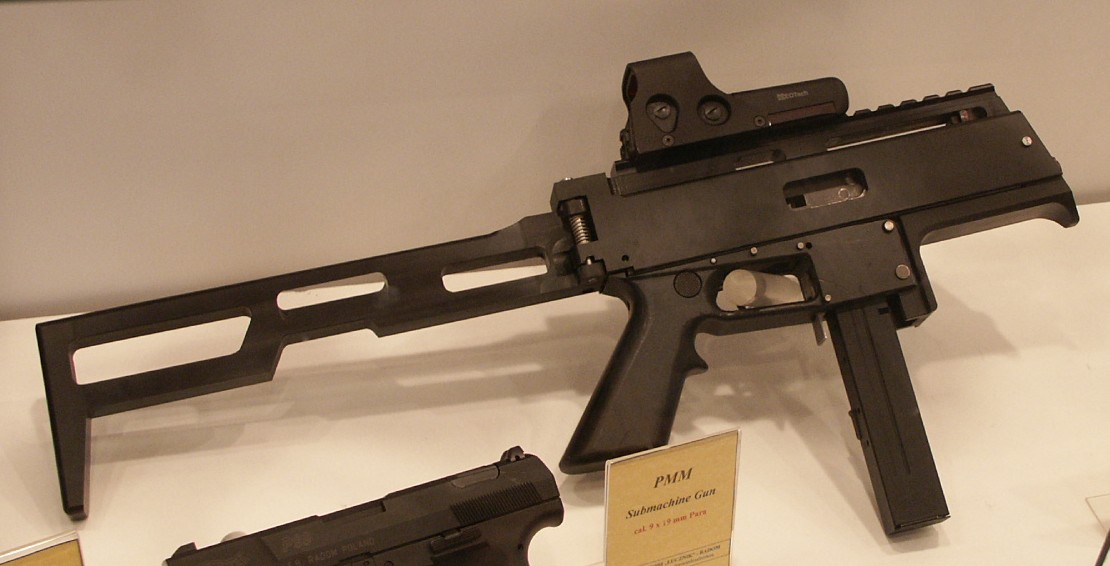
The dividing line between machine pistols and compact submachine guns is difficult to draw. While the term submachine gun usually refers to an automatic firearm larger than a pistol, several weapons are classed in both categories. The 1960s CZ-Scorpion, a Czechoslovak 7.65 mm weapon, for example, is often labeled a submachine gun. However, with its small magazine, it is small enough to be carried in a pistol holster, which suggests that it could be classified as a machine pistol. In the 1980s, weapons such as the MAC-10 and the compact versions of the Uzi series have been placed in both classes. The popularity of submachine guns in recent years has led many weapons previously described as machine pistols to be advertised to as submachine guns, such as the Brugger & Thomet MP9 (formerly known as the Steyr TMP).
The Steyr TMP (Tactical Machine Pistol) is a 9 mm blowback-operated, rotating-barrel weapon that is 282 mm long and that can fire 800-900 rounds per minute; despite its small size and lack of a stock, and the fact that it is called a "Tactical Machine Pistol", it is often classed as a compact submachine gun.[3] Likewise, the German Heckler & Koch MP5K (a weapon small enough to be concealed on one's person or in a briefcase), is also classed as a compact submachine gun.[4]
A machine pistol is typically based on a semi-automatic pistol design. While most machine pistols are designed to be fired with one hand, their light weight, small size, and extremely rapid rates of fire make them difficult to control. To improve accuracy, some machine pistols are fitted with a shoulder stock. Some, such as the Heckler & Koch VP70, will only fire single rounds unless the stock is attached, because there is a safety mechanism incorporated into the stock. The Beretta 93R offers an optional forward handgrip, which is another way of increasing weapon controllability in full automatic mode.

A machine pistol is a handgun-style, magazine-fed and self-loading firearm, capable of fully automatic or burst fire, and normally chambered for pistol cartridges. The term is a literal translation of Maschinenpistole, the German term for a hand-held automatic weapon. While the dividing line between machine pistols and compact submachine guns is hard to draw, the term "submachine gun" usually refers to larger automatic firearms scaled down from that of a full-sized machine gun, while the term "machine pistol" usually refers to a weapon built up from a semi-automatic pistol design.
In a law enforcement context, machine pistols are used by tactical police units such as SWAT teams or hostage rescue teams which are operating inside buildings and other cramped spaces, who need a small, concealable weapon with a high rate of fire. Bodyguards from police or government agencies sometimes carry concealed machine pistols when they are protecting high-risk VIPs. Criminal gang members such as narcotics traffickers also use machine pistols, typically cheaper guns such as the MAC-10 or the Tec-9 which have been illegally converted to fire in a fully-automatic fashion.
In a military setting, some countries issue machine pistols as personal defense sidearms to paratroopers, artillery crews, helicopter crews or tank crews. They have also been used in close quarters combat (CQC) settings where a small weapon is needed (e.g. by special forces attacking buildings or tunnels). In the 2000s, the machine pistol is being supplanted by the personal defense weapon: a compact, fully-automatic submachine gun-like firearm which fires armour-piercing rounds instead of pistol ammunition.


One of the main reasons for the resurgence of the Gatling gun-style design is the weapon's tolerance for continuous high rates of fire. For example, if 500 rounds were fired per minute from a conventional single-barrel weapon, this would likely result in the barrel overheating (distorting in extreme cases) or a weapon jam. In contrast, a five-barreled Gatling gun-style weapon firing 500 rounds per minute, only fires 100 rounds per barrel per minute, an acceptable rate of fire. Ultimately the limiting factor is the rate at which loading and extraction can occur. In a single barrel design these tasks must alternate, a multiple barrel design on the other hand lets them occur simultaneously, with different barrels at different points in the cycle. Their high rate of fire also makes them useful in systems that have little time to engage their targets, such as CIWS which defend against fast-moving anti-ship missiles.
The M61 Vulcan 20 mm cannon is the most prolific member of a family of weapons designed by General Electric and currently manufactured by General Dynamics. It is a six-barreled rotary cannon capable of more than 6,000 rounds per minute. Similar systems are available ranging from 5.56 mm to 30 mm (there was even a 37 mm Gatling on the prototype T249 Vigilante AA platform); the rate-of-fire being somewhat inversely-proportional to the size and mass of the ammunition (which also determines the size and mass of the barrels). Another Gatling design well-known among aviation enthusiasts is the GAU-8 Avenger 30 mm cannon, carried on the A-10 Thunderbolt II (Warthog) attack aircraft, a heavily-armored close air-support aircraft. It is a seven-barreled cannon designed for tank-killing and is currently the largest bore Gatling weapon active in the U.S. arsenal.
During the Vietnam War, the 7.62 mm caliber M134 Minigun was created as a helicopter weapon. Able to fire 6,000 rounds per minute from a 4,000-round linked belt, the Minigun proved to be one of the most effective non-explosive projectile weapons ever built and is still used in helicopters today. They are also used on USAF AC-47, AC-119 and Lockheed AC-130 gunships, their original high-capacity cargo airframes able to house the items needed for sustained operation. With sophisticated navigation and target identification tools, Miniguns can be used effectively even against concealed targets. The crew's ability to concentrate the Gatling's fire very tightly produces the appearance of the 'Red Tornado'[8] from the light of the tracers, as the gun platform circles a target at night.

The Gatling gun is one of the best known early rapid-fire weapons and a forerunner of the modern machine gun. Its first combat usage, and the battlefield role it is most well-known for, was its use by the Union forces during the American Civil War in the 1860s. Later it was also famously used in the assault on San Juan Hill during the Spanish-American War.[1]
Developed following the 1851 invention of the mitrailleuse by the Belgian Army, the Gatling gun was originally designed by the American inventor Dr. Richard J. Gatling in 1861 and patented in 1862.[2] He wrote that he created it to reduce the size of armies and so reduce the number of deaths by combat and disease.[3]
Although the first Gatling gun was capable of firing continuously, it required a person to crank it; therefore it was not a true automatic weapon. The Maxim gun, invented in 1884, was the first true fully automatic weapon, making use of the fired projectile's recoil force to reload the weapon. Nonetheless, the Gatling gun represented a huge leap in firearm technology. Prior to the Gatling gun, the only rapid-fire firearms available to militaries were mass-firing volley weapons as the mitrailleuse or grapeshot (as fired from cannons, similar to shotguns). And though rate of fire was increased by firing multiple projectiles simultaneously, these weapons still needed to be reloaded after each discharge, which for multi-barrel systems like the mitrailleuse was quite cumbersome and extremely time-consuming, thus negating their high rate of fire per discharge and making them impractical for use on the battlefield. In comparison, the Gatling gun offered a rapid continuous rate of fire without needing to manually reload.
The gun's operation centered around a cyclic multi-barrel design which facilitated cooling and synchronized the firing/reloading sequence. Each barrel fired a single shot when it reached a certain point in the cycle, after which it ejected the spent cartridge, loaded a new round, and in the process, cooled down somewhat. This configuration allowed higher rates of fire to be achieved without the barrel overheating. Some time later, Gatling-type weapons were invented that diverted a fraction of the gas pressure from the chamber to turn the barrels. Later still, electric motors supplied external power to operate the Gatling gun.


